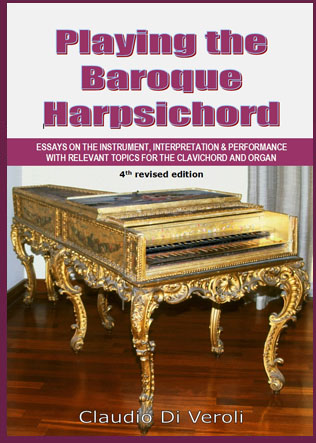

The unique opportunity to sponsor this major work is available. Like the
other eBooks by the same author, this one is expected to reach a
wide distribution and readership by students and performers of early keyboard
instruments, as well as researchers in the performance
of early music. If you are interested in sponsorship, please
contact Dr. Di Veroli at
.
Contents
of PLAYING THE BAROQUE HARPSICHORD
-
THE HARPSICHORD REVIVAL
- THE
HARPSICHORD FAMILY: INSTRUMENTS AND ACTIONS
- BAROQUE
FINGER MECHANICS
- BAROQUE
ARTICULATION
- BASICS
ON ESSENTIAL ORNAMENTS
- PERFORMING
THE NOTES INÉGALES
- INÉGALES
AND TRIPLETS IN BACH AND RAMEAU
- TEMPI:
AUTHENTICITY, RUBATO, TEMPI IN DIFFERENT COMPOSERS
- HARPSICHORD
STOP VOICING
- REGISTRATION:
USING THE STOPS IN DIFFERENT HARPSICHORD MODELS
- REGISTRATION
IN IMPORTANT BAROQUE HARPSICHORD WORKS
- REPERTOIRE
ISSUES: HARPSICHORD VS CLAVICHORD, ORGAN AND FORTEPIANO
- A
COMPLETE HARPSICHORD MULTILINGUAL DICTIONARY
- LITERATURE
CITED
Some
important features of the book
>
A presentation on the main ancient harpsichord models and keyboard ranges
(13 pages)
> A concise explanation of articulation in early keyboards, with
a list of sources and their implications (7 pages)
> A presentation on ornaments, with a comprehensive Table and
a full discussion of on-the-beat vs pre-beat (18 pages)
> A detailed presentation covering all the different aspects
of the performance of French notes inégales (19 pages)
> An analysis of the relationship between inégales,
triplets and overdotting in the works of Rameau and J.S. Bach (14 pages)
> A new approach for the performance of préludes non
mesurés. A general analysis of rubato in performance
>
Finding the authentic tempo for Baroque pieces, exemplified in works by
J.S. Bach, D. Scarlatti and Daquin (18 pages)
> Harpsichord voicing: finding the proper and authentic loudness
balance between the different harpsichord stops (11 pages)
> A full treatment of harpsichord registration, backed by historical
evidence, applied to works of different composers (25 pages)
> Finding the ideal type of instrument for the complete works
of Frescobaldi, J.S. Bach, Haydn and other composers (19 pages)
> The most complete ever Multilingual Harpsichord Dictionary
in English, French, German, Italian and Spanish (160 entries)
Why
an eBook?
This book can be read
on the screen of a PC, Mac and any device capable of showing documents
in Adobe Acrobat v.6.0 format or later. It is also formatted for impeccable
printing on Letter paper, A4 or A5 (two pages in an A4 sheet). Benefits
of buying an eBook vs a ready-printed volume:
PRICE: less than 1/4th of the estimated price of a printed
volume.
AVAILABILITY: an eBook is never out of print.
SECURITY: the reader can make a backup copy, so that the eBook
cannot be lost or stolen.
PRINTING: if a printed volume is really needed, the reader
can print it from any home computer.
MANY FIGURES: more than 77 figures, many of them photos
and/or in full-colour.
PORTABILITY: the reader can carry the book around in a laptop computer
or other portable device.
INTERNAL LINKS: internal hyperlinks, allowing the reader
to "jump" to other parts of the eBook and "jump back"
as well..
WEB ADDRESSES: they allow the reader to access on the
spot web pages referred to.
REFERENCE:
the reader interested in a particular topic can quickly search and find
all the references to it in the eBook.
TIMELINESS:
you buy the eBook and receive it on the spot.
This new book is
a 9Mbyte document file. It downloads in less than 3 minutes using an Internet
broadband service.
Comments
from readers
"Bravo!
This is a major undertaking!"
"..
I bought your e-book Playing the Baroque Harpsichord and am thorougly
enjoying it. Clear, detailed writing and lots of good illustrations. I will
recommend it ...! "
"...
You have done everything in such a logical manner and with such excellent
method ... "
"...
I enjoyed your book a great deal. ... I have just had all my questions
about inégalité and more answered. It is a relief
to find a work based on scientific thinking, and very clearly written.
A surprisingly easy read, despite the wealth of information!"
"I
have read your e-Books and benefitted greatly from each one."
"I
strongly recommend Claudio's beautiful book."
Book
Review in The British Clavichord Society Newsletter
Find
below excerpts from the review written by the distinguised British harpsichordist
Penelope Cave, published in The
British Clavichord Society Newsletter, No.49, February 2011. This
is a very thorough and positive review. It also contains some observations
that I have addressed in a letter published in The British Clavichord
Society Newsletter, No.50, June 2011. In the text below a few clarificationsnot
in the original reviewhave been inserted between curly brackets
{ }.
"Playing
the Baroque Harpsichord is a mighty title, encompassing (if it were
merely confined to the historical Baroque,
c.16001750, which it is not) one hundred and fifty years of instrument
making and a panoply of composers and theorists.
It is a brave man who takes on these revered, controversial and puzzling
historic figures, who have been interpreted and translated through the
lens of each age including our own, and probably as often misunderstood.
... Dr Claudio Di Veroli ... , a statistician, ... also found time to
give concerts on both harpsichord and organ and to publish two well-received
books on unequal temperaments and early fingering, so he confidently embarks
on this project with the same logical, scientific approach, in order to
extract proof and results. He generously shares his ideas on speed, use
of manuals, choice of stops and ... inégalité ...
with illustrations, tables and coloured text boxes. His main interest
is, indeed, in the High Baroque of Bach, Couperin and Rameau,
and he refers to both contemporary theorists and twentieth-century writers
on Baroque practice. ...
There are eight chapters, each sub-divided
into sections; thus the first chapter, Instruments and Actions,
consists of sections on the harpsichord family, how to choose between
historical models, keyboard ranges, the jack, a section entitled inexpressive
keyboard, and one on tuning and maintenance. His discussion of keyboard
ranges, split keys and jacks is useful, and he demonstrates his theory
of eleven stages of jack-action in a clear, coloured diagram, along with
two more to explain string and jack alignment.
Chapter 2, on finger mechanics and articulation
... Di Veroli has the gift of making you think ... His decided opinions
on joining and detaching of notes, and his interpretations of what he
calls the ancients doings and documentation will certainly
promote thought about the proportions of sound to silence within note-lengths,
and possibly some healthy discussion.
In Chapter 3, on ornamentation, Di Veroli
offers, in his own words, a comprehensive but succinct guide.
... useful comments that follow his Table of Baroque Essential Ornaments.
... There is a good section on Italianate embellishment and {in Chapter
4} a long one on French inégalité ... Di Veroli
is aware that only experienceunder a good guidewill
show what to do, and ... he rightly says the modern musician
often needs years of study to incorporate inégales in a
musically-satisfying way.
The section on Bachs use of triplets
and sesquialter notation offers us more food for thought. I would say
that Bachs use of inégalité is well-covered
elsewhere ..., but Di Veroli gives suggestions as to where and when it
should be used in Bachs keyboard works. ...
{In Chapter 5 on tempi} Di Verolis
theory that slower tempi are desirable because it is well documented
that Baroque musicians rehearsed pretty little, if at all, is one
to enjoy. He gives some metronome speeds for Bachs concertos and
the Goldberg Variations, Scarlatti sonatas, and Daquins four suites.
{Chapter 6 on harpsichord Voicing, like}
Chapter 7, on harpsichord registration, is not for clavichord players
{readers of the British Clavichord Society Newsletter}.
Chapter 8 ... deals with repertoire issues.
Di Veroli ... airs the arguments against the clavichord being of particular
interest to
J. S. Bach. He admits that, for many players, all Bachs keyboard
works that are not specifically harpsichord pieces were conceived for
the clavichord, and discusses why the kleine Präludien für
Anfanger might have been intended for that instrument. He maintains,
however, that most of the pieces in Book I of The Well Tempered Clavier
are harpsichord music only, since most would be impossible on the common
triple-fretted clavichords of the time. Of Book II, he says unfretted
clavichords were now fast becoming fashionable in German-speaking countries.
The author finds that most pieces in the WTC II are compatible for any
stringed keyboard ... [and his exceptions follow]. His statistical
argument against the well-known Organ Toccata and Fugue in D minor (BWV
565) being by Bach is a tour de force ... To finish the last chapter,
he makes a list of Haydns sonatas and suggests suitable keyboards:
this is not a new idea, but it is usefully constructed ...
There are six appendices, all thoroughly
practical. Among them is a multilingual dictionary, giving equivalent
terms for wood types in six languages and parts of instruments and maintenance
terms in five; a glossary giving definitions of each of these terms in
English; an essay on logical methods; and finally a musical-history
puzzle or quiz question."
|